Membrane damage, open seams, punctures, blistering, ponding water, and drainage problems on flat and low-slope roofing systems. Material-compatible repair for commercial and residential Fort Lauderdale properties.
Flat and low-slope roofs face unique challenges in South Florida's heavy-rain, high-UV environment that differ significantly from pitched roof concerns.
Fort Lauderdale receives intense seasonal rainfall that overwhelms drainage systems designed for lighter loads. When roof drains clog, scuppers block, or the roof slope is insufficient, water ponds on the membrane surface. Standing water accelerates membrane deterioration, adds structural load, and creates concentrated leak points at seams and penetrations.
Membrane seams are the most vulnerable points on a flat roof. Thermal cycling, UV degradation, and mechanical stress cause seam adhesion to fail over time. In Fort Lauderdale's heat, membrane surfaces reach extreme temperatures that accelerate adhesive breakdown. Once a seam opens, water enters the roof assembly directly, often traveling laterally before becoming visible inside the building.
Moisture trapped between membrane layers or between the membrane and insulation expands in South Florida's heat, creating blisters and bubbles. When blisters rupture, they expose the underlying layers to UV and water. Surface deterioration — including cracking, alligatoring on modified bitumen, and UV-induced embrittlement — reduces the membrane's remaining service life.
Flat roofs typically have multiple penetrations — HVAC units, vents, conduit runs, drain assemblies, and equipment supports. Each penetration requires flashing or membrane detailing that can fail independently. Equipment vibration, thermal movement, and sealant degradation at these transitions are among the most common flat roof leak sources.
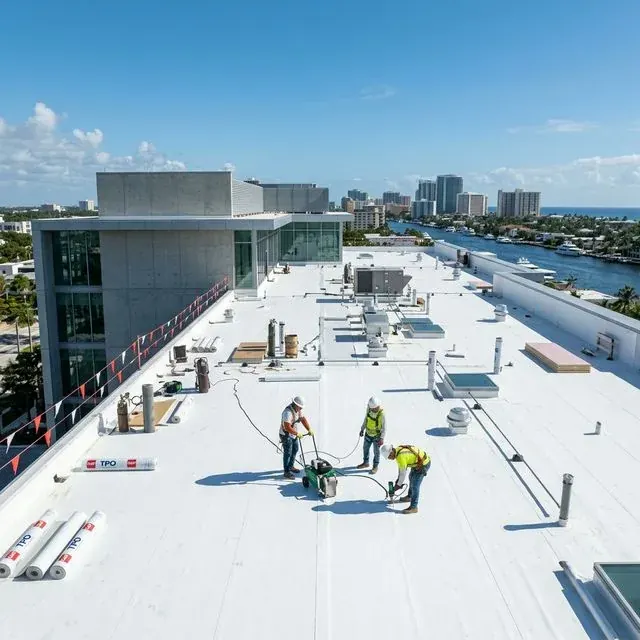
Flat roof repair requires understanding the specific membrane system installed and using compatible materials and techniques. Applying incompatible patches or sealants can worsen the problem by trapping moisture or failing to bond properly to the existing surface.
Fort Lauderdale commercial and residential flat roofs use various membrane systems — TPO, modified bitumen, EPDM, and built-up roofing. Each requires different repair materials, adhesion methods, and surface preparation. We identify the installed membrane type before recommending a repair approach to ensure material compatibility.
Ponding water is not merely an aesthetic issue — it is an active accelerant of membrane failure. We evaluate drainage paths, drain conditions, scupper function, and roof slope to identify why water is accumulating. Clearing obstructed drains and ensuring proper water flow is often an essential component of flat roof repair in Fort Lauderdale's heavy-rain environment.
Open seams and failed flashing at penetrations account for the majority of flat roof leaks. Seam repair involves cleaning, priming, and re-adhering or welding the membrane using methods appropriate to the system. Flashing at equipment bases, drain connections, and edge terminations is evaluated and corrected to restore waterproof integrity at these critical transitions.
Many flat roof repairs in Fort Lauderdale involve commercial buildings where tenant coordination, operational schedules, and access logistics add complexity. We communicate repair timelines and access requirements clearly so that building managers and tenants can plan accordingly. For a complete view of our services, visit our Fort Lauderdale roof repair overview.
Flat roofs are designed with slight slopes to direct water toward drains, scuppers, or edges. Ponding occurs when drains are blocked, slope is insufficient, or the membrane has settled. Standing water accelerates membrane deterioration and increases leak risk.
Yes, when the damage is localized — such as a puncture, open seam, or small blistered area — patching with compatible membrane material is practical. Widespread membrane failure or extensive seam separation may indicate the system needs broader attention.
Common flat roof membranes in Fort Lauderdale include TPO (white, single-ply), modified bitumen (granulated or smooth surface), EPDM (black rubber), and built-up roofing. A professional inspection can identify the membrane type and recommend compatible repair materials.
Schedule a professional flat roof inspection. We evaluate membrane condition, drainage function, and penetration sealing.